We arrived the evening before, in the last hour of light, and were told to sleep early. The pickers begin before the sun is up; by the time it touches the plateau, the flowers must already be gathered. What blooms in the light closes by midday, and what closes by midday has lost its water — the threads inside the flower stiffen, and the stiffened thread is a lesser thread. The whole harvest is a race with the sun.
The fields are lower than one imagines, and quieter. There are no engines. The crocus opens for a few hours between mid-October and early November — the exact days shift with the weather, and the household calendars in the villages shift with them. A wedding will be moved. A market will be moved. The saffron does not move.
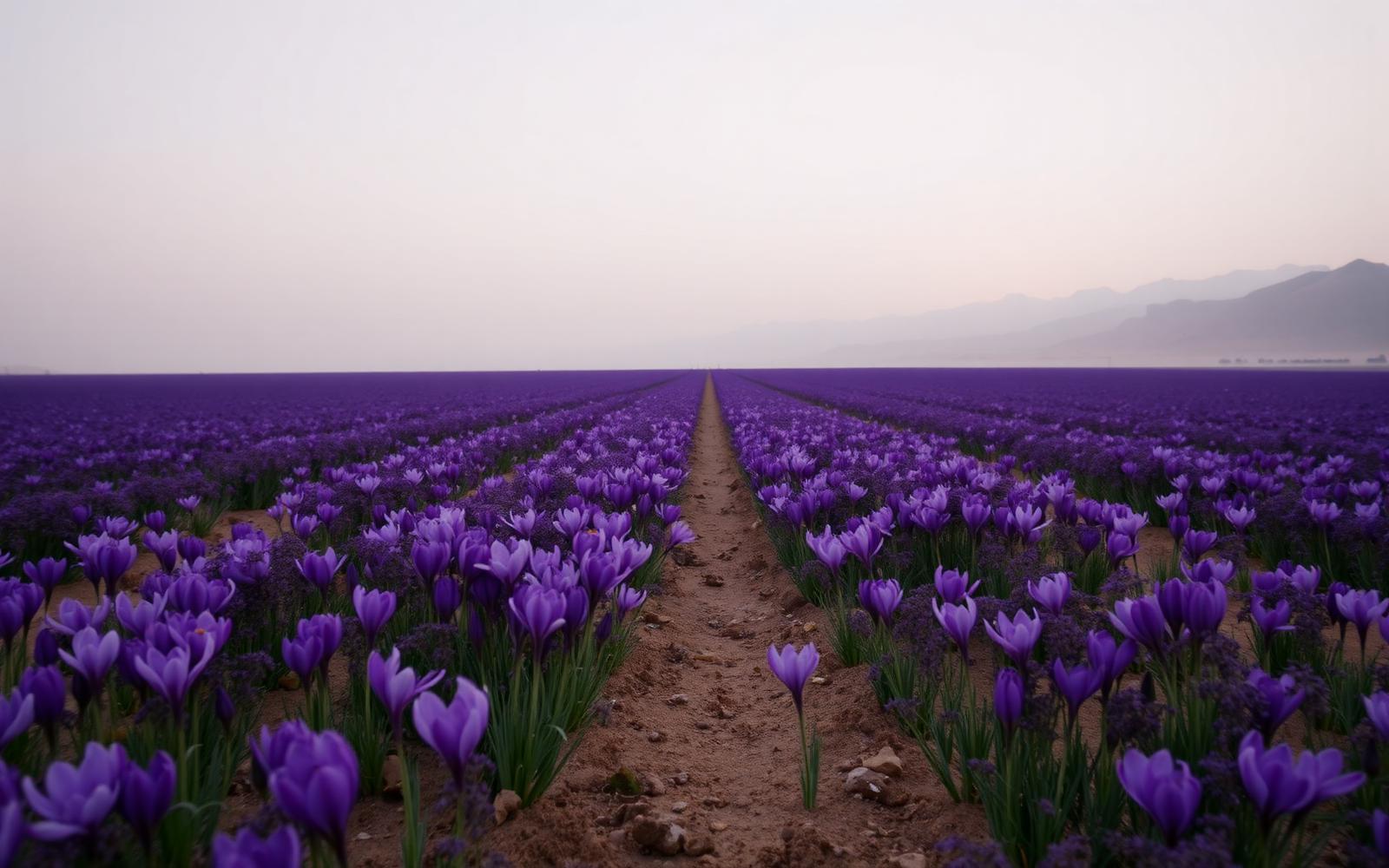
By nine the baskets are inside. The flowers are laid on low tables in rooms with the shutters half-drawn, and the separation begins. Three crimson threads are lifted from each flower with the fingers — never a tool — and dropped into a shallow dish. What the fingers cannot feel, the eye cannot see; the work belongs to the hand.
The count
One hundred and fifty flowers yield one gram. It is worth stating slowly. Between the field and the gram there are twelve hands, four rooms, a night of quiet drying, and a house that has done this for generations. The number is not a marketing figure; it is arithmetic and it is the reason the spice is what it is.
We left with two crates, sealed and signed, and a promise to open them once more in Paris. The second selection is ours; the first is theirs, and the first is not ours to improve. What we do in the atelier is smaller and quieter than what has already been done here, and we mean to keep it that way.